One of the biggest misconceptions in Florida real estate is the idea that our “As Is” contract means you are buying the house no matter what the inspection uncovers. That is not really how the FAR/BAR As Is contract works in the real world.
The FAR/BAR contract, the standard Florida real estate contract created jointly by Florida Realtors and The Florida Bar, is what most buyers and sellers use in residential transactions throughout Florida.
We hear this all the time from buyers after inspections in South Florida. They fall in love with a home, get under contract, and then the inspection report comes back with a laundry list of concerns. Maybe the roof is near the end of its life. The air conditioning system is old. The inspector mentions possible electrical problems. Suddenly what felt exciting starts feeling risky.
The good news is that the FAR/BAR As Is contract still gives buyers meaningful protections during the inspection period. In fact, despite the words “As Is,” the contract is really designed to allow buyers to fully investigate the property and then decide whether they still want to move forward.
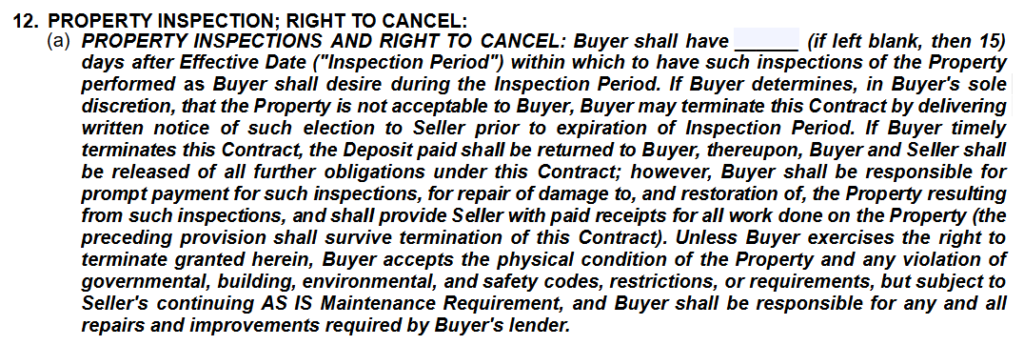
A better way to think about the FAR/BAR As Is contract is that it gives the buyer a very clear right to cancel during the inspection period. The buyer does not have to prove that the roof is bad, the air conditioning is failing, or the electrical system is unsafe. If the buyer determines, in the buyer’s sole discretion, that the property is not acceptable, the buyer can cancel as long as the cancellation is delivered properly and before the inspection period expires.
“If Buyer determines, in Buyer’s sole discretion, that the Property is not acceptable to Buyer, Buyer may terminate this Contract by delivering written notice of such election to Seller prior to expiration of the Inspection Period.”
If the buyer properly cancels during the inspection period, the escrow deposit should be returned according to the contract. That is why I often tell buyers the “As Is” contract is really more of a “right to cancel” contract during the inspection window.
A lot of people assume “As Is” means the seller refuses to negotiate or fix anything. That is not necessarily true. What it really means is the seller is not automatically obligated to make repairs upfront. Buyers still have the ability to negotiate if serious issues are discovered.
During the inspection period, buyers can ask the seller to address certain problems, negotiate a price reduction, request a credit toward closing costs, or simply walk away and recover their deposit if the issues are too significant and the parties cannot come to an agreement.
In many cases, asking for a closing credit works better than asking the seller to actually coordinate repairs. Most sellers do not want to deal with contractors, permits, delays, and scheduling repairs on a home they are preparing to leave. A credit also gives the buyer more control over the quality of the work and who performs it after closing.
This becomes especially important in Florida because inspection issues are often tied directly to insurance concerns. A roof may still technically function, but if it is too old, it could create problems getting affordable homeowners insurance. The same goes for older electrical panels, outdated wiring, plumbing issues, or aging air conditioning systems. In Florida’s current insurance environment, buyers are not just evaluating repair costs. They are evaluating future insurability as well.
That is why I always tell buyers not to rely solely on the general inspection report when major concerns are flagged. A general inspector is there to identify possible problems, but specialists are the ones who tell you what those problems actually mean. If the report raises concerns about the roof, bring in a roofer. If there are electrical concerns, hire a licensed electrician. The same goes for HVAC systems, plumbing, structural concerns, or anything else that could become a major expense after closing.
Those secondary inspections are often more important than the original inspection itself because they help buyers understand the true cost and severity of the issues.
If you need more time to complete those evaluations, it is often worth asking the seller for a short extension to the inspection period. Reasonable sellers will sometimes agree, especially when legitimate concerns are involved. But if the seller refuses to allow enough time to properly evaluate serious issues, that alone can tell you something about the transaction.
The most important thing buyers need to understand is that timing matters. The inspection period under the FAR/BAR As Is contract is incredibly important. Once that deadline passes, your leverage changes dramatically. If you are going to cancel the contract, it needs to happen properly, in writing, and before the inspection period expires. Missing deadlines is how buyers end up fighting over deposits in situations that should have been straightforward.
It is easy to get emotionally attached to a house. Buyers start imagining holidays, renovations, family gatherings, and their future life there. But loving a house is not a financial strategy. You still have to look at the numbers honestly and ask yourself whether you would want the property if the worst-case repair estimates become reality.
If the answer is yes, then negotiate firmly and move forward with confidence.
If the answer is no, then talk to your buyer’s agent about your options.