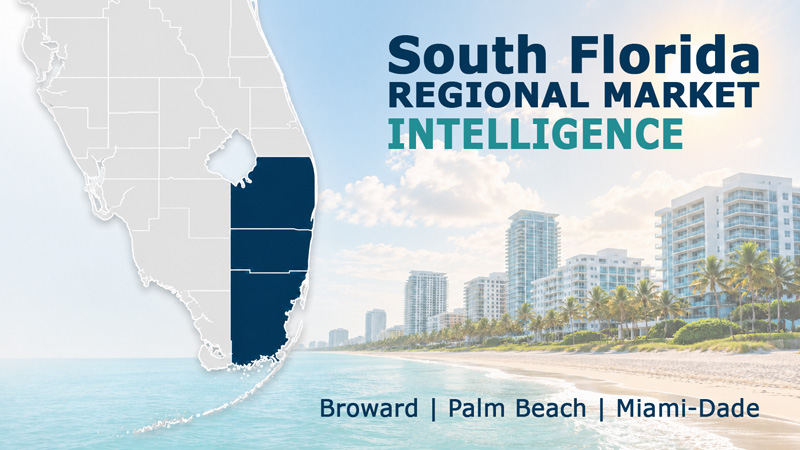
Summer Trends for South Florida Homes and Condos
Data reflects July 2026 activity and year-over-year comparisons from Florida Realtors® SunStats.
South Florida Region – Executive Summary
South Florida residential real estate remained relatively firm in July as active inventory and months of supply continued to decline across every market throughout the region. Single-family homes remained the tighter market, while the condominium sector continued to offer buyers more selection and a wider range of outcomes by county.
South Florida single-family sales rose 9.1% from a year ago, with the median sale price increasing 4.3% and months of supply tightening to 4.2 months. Condos and townhouses also posted an 8.0% increase in closed sales, but the regional market still carried 9.6 months of supply and a much longer median marketing time of 81 days.
At the county level, Palm Beach continued to show the strongest overall fundamentals, with the lowest supply in both property types and the strongest price growth in the single-family segment. Miami-Dade remained the highest-priced single-family market and the most buyer-favorable condo market, while Broward’s condo segment showed the weakest short-term momentum with both sales and median prices showing modest declines.
As South Florida moves deeper into the summer selling season, the key question is whether buyer demand remains strong enough to keep absorbing inventory without requiring broader price adjustments. That outlook appears more favorable for single-family homes than for condos and townhouses, where longer days on market and building-specific factors continue to shape buyer behavior.
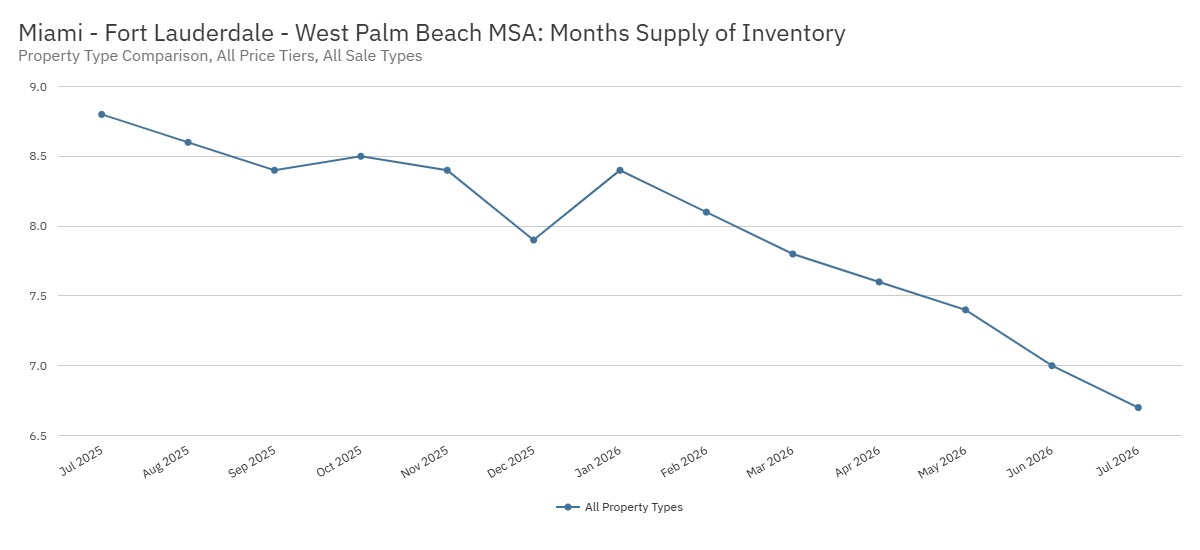
South Florida’s July market remained stable to improving overall, with single family and condo inventory down 6 straight months
South Florida MSA
Includes data for the Miami – Fort Lauderdale – West Palm Beach MSA (Metropolitan Statistical Area)
Regional Market Comparison – Single Family and Condos
| Metric | Single-Family Homes | Condos & Townhouses |
|---|---|---|
| Active Inventory | 13,281 (down 24%) | 26,710 (down 15%) |
| Median Days on Market | 40 days (down from 44) | 81 days (up from 68) |
| Months of Supply | 4.2 months (down from 6.0) | 9.6 months (down from 11.9) |
| Closed Sales | 3,384 (up 9.1%) | 2,958 (up 8.0%) |
| New Pending Sales | 3,332 (up 2.7%) | 2,927 (down 0.8%) |
| Median Sale Price | $665,000 (up 4.3%) | $325,000 (up 1.6%) |
The South Florida MSA remained broadly stable in July, with lower inventory continuing to support both single-family and condo sales activity. Single-family homes remained the more competitive market, with 4.2 months of supply, faster marketing times and stronger price support, while the condo market continued to show a wider gap between improving sales and softer buyer urgency.
Strategic takeaway: The regional market continues to improve gradually, but condos and townhouses remain meaningfully more buyer-friendly than single-family homes.
Broward County
Includes data for coastal communities of Fort Lauderdale, Lauderdale-by-the-Sea, Lighthouse Point and Pompano Beach
Single-Family Conditions Stayed Firm While Condo Momentum Softened
| Metric | Single-Family Homes | Condos & Townhouses |
|---|---|---|
| Active Inventory | 4,416 (down 25%) | 9,533 (down 16%) |
| Median Days on Market | 34 days (down from 43) | 86 days (up from 71) |
| Months of Supply | 4.3 months (down from 6.0) | 10.0 months (down from 12.0) |
| Closed Sales | 1,139 (up 8.0%) | 1,018 (down 2.8%) |
| New Pending Sales | 1,152 (up 5.0%) | 1,024 (down 3.8%) |
| Median Sale Price | $650,000 (up 4.8%) | $255,000 (down 3.8%) |
Broward’s single-family market remained comparatively healthy in July, with lower inventory, a faster median days on market and gains in both closed and pending sales. The condo market was notably weaker, with closed sales and pending sales both declining from a year ago, the median price falling 3.8% and marketing times stretching to 86 days despite the reduction in active inventory and months of supply.
Strategic takeaway: Broward’s single-family segment remains firm, but the condo market is currently the weakest of the three counties based on sales momentum, price direction and buyer pace.
Palm Beach County
Palm Beach Continued to Show the Strongest Overall Fundamentals
| Metric | Single-Family Homes | Condos & Townhouses |
|---|---|---|
| Active Inventory | 4,590 (down 23%) | 5,853 (down 19%) |
| Median Days on Market | 41 days (down from 46) | 69 days (down from 70) |
| Months of Supply | 3.7 months (down from 5.5) | 6.7 months (down from 9.3) |
| Closed Sales | 1,336 (up 13%) | 914 (up 19%) |
| New Pending Sales | 1,264 (up 5.4%) | 860 (up 0.7%) |
| Median Sale Price | $660,090 (up 7.6%) | $312,500 (up 4.0%) |
Palm Beach continued to lead the region in overall market balance, with the lowest supply in both property types and healthy year-over-year gains in pricing and sales. The single-family market remained the tightest in South Florida at 3.7 months of supply, while the condo market also looked relatively balanced, with improving pricing, strong sales growth and slightly faster marketing times.
Strategic takeaway: Palm Beach remains the strongest overall county market, combining lower supply with improving sales and pricing in both single-family homes and condos.
Miami-Dade County
Firm Single-Family Pricing and a More Buyer-Favorable Condo Market
| Metric | Single-Family Homes | Condos & Townhouses |
|---|---|---|
| Active Inventory | 4,275 (down 23%) | 11,324 (down 12%) |
| Median Days on Market | 45 days (up from 44) | 86 days (up from 65) |
| Months of Supply | 4.8 months (down from 6.6) | 12.0 months (down from 14.1) |
| Closed Sales | 909 (up 5.6%) | 1,026 (up 11%) |
| New Pending Sales | 916 (down 3.5%) | 1,043 (up 1.1%) |
| Median Sale Price | $685,000 (up 3.8%) | $400,000 (down 1.5%) |
Miami-Dade’s single-family market remained relatively firm, with lower inventory and continued price growth, although the decline in pending sales suggests buyer demand may be moderating somewhat. The condo market remained the most buyer-favorable in the region, with 12.0 months of supply, a declining median price and 86 median days on market, even as closed sales improved from a year ago.
Strategic takeaway: Miami-Dade continues to offer the region’s clearest split between a relatively stable single-family market and a slower-moving condo market with meaningful buyer leverage.
What the Market Means for You
For Buyers
Single-family buyers still face tighter inventory and less negotiating room than condo buyers, especially in Palm Beach and stronger Broward neighborhoods. Buyers considering condos and townhouses generally have more leverage, but should continue paying close attention to association finances, reserve funding, insurance costs, assessments and overall building quality.
For Sellers
Single-family sellers continue to benefit from reduced supply, but buyers remain selective and price-sensitive, so accurate pricing and strong presentation still matter. Condo sellers face more competition and a longer marketing window, particularly in Broward and Miami-Dade, where building fundamentals may influence buyer interest as much as the individual unit itself.
Key Takeaways
- Regional single-family sales increased 9.1%, while condos and townhouses posted an 8.0% gain in closed sales.
- Inventory declined across every county and property type, continuing to tighten supply throughout South Florida.
- Palm Beach showed the strongest overall fundamentals, with the lowest supply in both property types and strong price growth.
- Broward’s condo market showed the weakest short-term momentum, with lower sales, lower pending sales and a 3.8% decline in median price.
- Miami-Dade remained the most buyer-favorable condo market, with 12.0 months of supply and 86 median days on market.
Regional Outlook
South Florida’s July data suggests that the second half of 2026 is beginning with relatively stable market conditions and continued inventory absorption. The outlook remains strongest for single-family homes, where supply is still comparatively limited, while the condo market will depend more heavily on whether buyer demand can keep pace with higher inventory levels, longer marketing times and ongoing building-related decision factors.